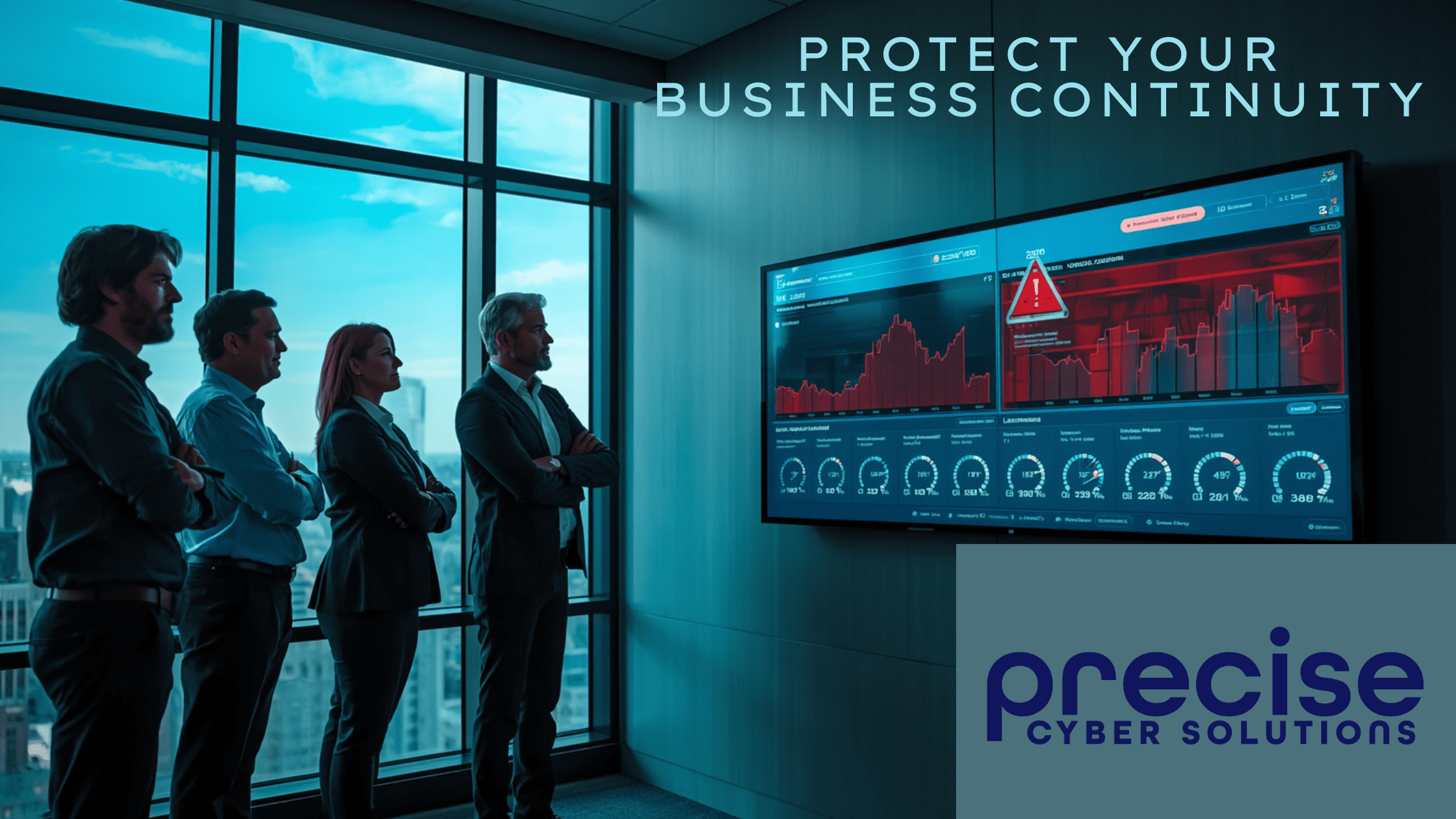
Ask a CEO what keeps them up at night regarding cybersecurity risk, and you probably won’t hear terms like “lateral movement” or “zero-day exploits.” What they’re preoccupied with is of much more fundamental concern: “What happens if we can’t operate?”
That question cuts to the heart of what cybersecurity actually means for business leaders — not the technical mechanics of an attack, but the operational and financial consequences of one. And yet most security programs are still built, measured, and conveyed in ways that never quite connect with that boardroom reality.
That disconnect is costing organizations more than they realize. Not just in dollars, but in executive buy-in, program funding, and the strategic alignment that turns a reactive IT function into a genuine business protection capability.
The Numbers That Actually Matter
Downtime costs small and mid-sized businesses an average of $53,000 per hour. The average ransomware-related outage lasts 24 days.
When you do the math, you realize that 24 days of operational disruption at $53,000 a day is more than just a cybersecurity problem. It’s a fundamental problem for most mid-market organizations that threatens payroll, customer contracts, vendor relationships, and in many cases, the business itself.
Yet, security programs are routinely under-resourced, under-communicated, and undervalued, not because leadership doesn’t care about risk, but because the conversation rarely frames risk in recognizable terms. When CISOs talk about patch cycles and endpoint coverage, CEOs hear IT maintenance. When the conversation shifts to detailing what 72 hours of downtime costs the business, the entire dynamic changes.
Availability Resilience: A Different Way to Frame Security
The concept of availability resilience reframes the purpose of a security program around a single, business-grounded question: Does this keep the organization running? Every firewall rule, every access control policy, every incident response drill, and every vendor risk review: Each should be evaluated through that lens. The question should not be “is this technically sound?” but rather “does this reduce our exposure to operational disruption?”
This is not a compromise of security rigor; it is an elevation of it. A security program built around availability resilience is one that prioritizes the controls, processes, and recovery capabilities most likely to protect business continuity when — not if — an incident occurs. Availability resilience integrates threat detection with rapid response, connecting backup and recovery architecture to defined recovery time objectives. It ensures that when leadership asks “how quickly can we be back up?” the security team has a tested, credible answer.
Framing Changes Everything
Security leaders often struggle to secure funding and organizational commitment. The risk is certainly real, but the risk isn’t communicated in the language of business consequence.
Availability resilience provides that language. When you frame a security investment as downtime prevention — when you can show a leadership team that a particular control or program directly reduces the likelihood or duration of an operational outage — security stops being a cost center conversation and becomes a business continuity conversation. That makes it a boardroom priority, not an IT line item.
This framing shift is frequently the difference between a security program that gets the resources it needs and one that operates perpetually underfunded. Leaders who control budget allocations understand revenue, operations, and customer commitments. They understand what it means to lose the ability to serve clients for a week. They may not fully appreciate the nuance of a misconfigured access policy, but they will absolutely understand the downstream consequence of one.
What Availability-First Security Looks Like in Practice
For mid-market organizations, building an availability-first security posture means asking harder questions during program design:
- What are our most operationally critical systems, and are they our most protected?
- Do our incident response plans include clear recovery sequencing tied to business priorities?
- Have we tested our backup and restoration capabilities against realistic attack scenarios, including ransomware encryption?
- Does leadership have visibility into recovery time objectives, and are those objectives actually achievable with our current architecture?
- Are our vendor and third-party risk reviews accounting for supply chain disruption, not just data exposure?
These are questions that connect technical security decisions to operational outcomes. They build a program that leadership can see, understand, and fund.
Security Is a Business Function
The organizations that weather cyber incidents best are not necessarily the ones with the most sophisticated tools. They are the ones that treat security as a core business function, measure it against business outcomes, and build recovery capability alongside prevention.
Availability is not a security afterthought. It is the metric that matters most when an incident is underway. Leadership needs to know one thing: How soon can we get back to running? Build your security program to answer that question with confidence.
Availability resilience is not a product you buy. It is a program you build with the right strategy, the right leadership, and the right framing for the people who control the budget.
Precise Cyber Solutions works with mid-market organizations as a fractional CISO partner, helping leadership teams build security programs that protect operations, reduce downtime risk, and translate technical exposure into clear business decisions.
If your security program isn’t yet measured against availability and continuity, that’s where we start.
Explore Fractional CISO and Strategic Cybersecurity Governance